Are All of the Psalms Included in the Book of Common Prayer Readings


And Administration of the Sacraments, And Other Rites and Ceremonies of the Church,
Co-ordinate to the Utilize of the Church of England: Together with the Psalter or Psalms
of David, Pointed as they are to be sung or said in Churches.
Cambridge, Printed past John Archdeacon Printer to the University;
and Sold by John Beecroft, John Rivington, Benjamin White,
and Edward Dilly, in London; and T. & J. Merrill,
in Cambridge, 1771.
Bound Together with . . .
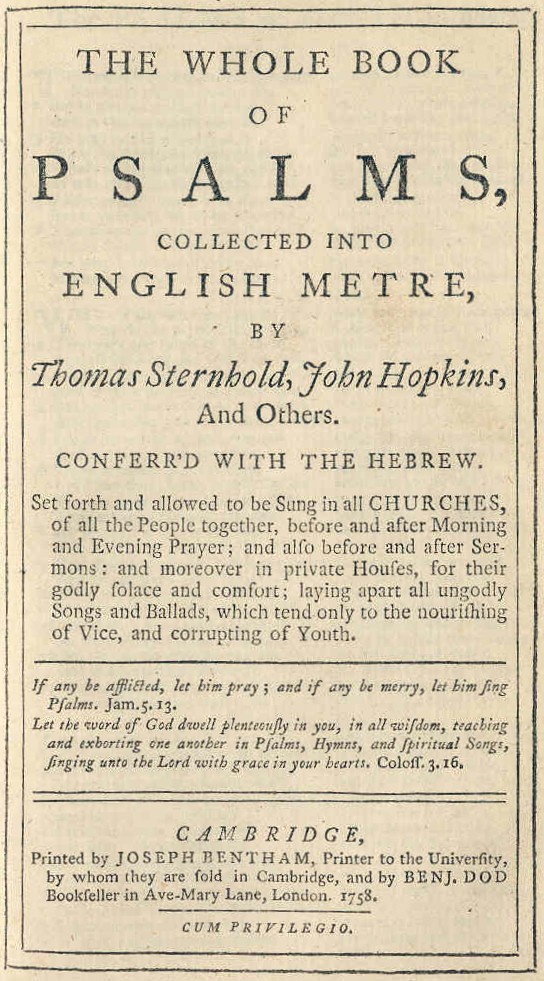
The Whole Volume of Psalms, Collected into English language Metre.
By Thomas Sternhold, John Hopkins, and Others.
Conferr'd with the Hebrew.
Cambridge: Printed by Joseph Bentham, Printer to the University,
by Whom They are Sold in Cambridge, and past Benj. Dod
Bookseller in Ave-Mary Lane, London 1758.
The Book of Mutual Prayer:
Influence on William Carey
Born and baptized into an Anglican dwelling in 1761, William Carey was the son of Edmund Carey, a parish clerk and schoolmaster. Brought up equally an Anglican, Carey would have been familiar with the two nigh important books in English: the King James Version of the Bible (commencement published, 1611) and The Book of Common Prayer, the leading English language liturgical guide to prayer, scripture reading, and religious devotion. The importance of these two books on William Carey cannot be overstated. Later on the founding of the British and Foreign Bible Society (i.due east., BFBS) in 1804 by Dissenters, the dominance of these two Anglican books continued among people in the Established Church building of England. In 1810, a review of the potential disharmonize between the BFBS and Anglican Social club for the Promotion of Christian Knowledge appeared in The Quarterly Review. The outcome�from the Establishment bespeak of view�was whether the BFBS should have been formed and whether Institution members (i.e., Anglicans) should belong to the BFBS. In the course of the review, a pertinent passage (p. 74, p. 75) concerning the importance of the Rex James Version and The Book of Common Prayer appeared, which said,
At the present time then we stand with our Bible in one paw, and our Mutual Prayer in the other. We must bandage away neither. Looking at both, indeed, we see the identity of their principles. This is our strong ground. Our Liturgy is drawn from the Scriptures, and we debate, that it may be resolved into them again past the soundest process of argument, and by the most verbal tracing of regime. Merely, thus extracted from the Scriptures, it is to be for ever maintained, together with them, by all the truthful sons of the Church. It is the external monument and test of our Establishment; and hence we are spring, in a peculiar caste, to maintain the Book of Common Prayer, and all the doctrines calculated for its support. Only by preferring the Bible alone to the Bible and Liturgy united, we render to the imperfect country in which we were before the completion of our Reformation. This road, indeed, is open to Dissenters (p. 75).
In his role as parish clerk, Edmund Carey non only was responsible for advocating these two most important books, only also he had to maintain parish records related to church attendance and donations, baptism, marriage, death, deeds, and wills. Most important for immature William'due south upbringing, however, was Edmund's responsibility to serve at the church building altar and office equally a lector in Dominicus church services. In Edmund'due south office every bit a lector, William would have heard his begetter read the King James Version, The Book of Common Prayer, and to lead the choir and congregants in singing and responsorial lessons from The Book of Common Prayer or a common hymnal such as The Whole Volume of Psalms. Such order was William Carey's formative religious education.
In Eustace Carey's Memoir of William Carey, D.D., (p. 5), William Carey conveys the content and method of his Anglican upbringing:
In the commencement fourteen years of my life, I had many advantages of a religious nature, but was wholly unacquainted with the scheme of salvation by Christ. During this fourth dimension I had many stirrings of mind, occasioned by my being often obliged to read books of a religious character; and having been accustomed, from my infancy, to read the Scriptures, I had a considerable acquaintance therewith, especially with the historical parts. I also have no doubt but the constant reading of the Psalms, Lessons, & c., in the parish church building, which I was obliged to nourish regularly, tended to furnish my mind with a general Scripture cognition.
The Book of Common Prayer:
History and Content, 1549-1771
The history of The Book of Common Prayer probably began with Thomas Cranmer, Archbishop of Canterbury, 1533-1556. In 1549, Cranmer produced the first Book of Common Prayer. Several revisions to Cranmer'due south work occurred between 1549 and Carey'south early life in Northamptonshire, 1761-1780. Some significant editions of the Volume of Common Prayer include the following editions as presented past the Anglican Gild of Archbishop Justus, which maintains an elaborate web page devoted to The Book of Mutual Prayer.
-
The Sarum Missal (in use in English language churches prior to the Book of Mutual Prayer)
-
1544, The First Liturgy in English
-
1548, The Order for Communion
-
1549, Book of Mutual Prayer (the showtime)
-
1552, Volume of Common Prayer (the 2d prayer book of Edward Half-dozen)
-
1559, Book of Common Prayer (the Elizabethan prayer volume)
-
1662, Book of Common Prayer
-
The 1662 Volume of Common Prayer (every bit printed by John Baskerville, 1762)
For histories of The Book of Common Prayer, click on the links below which are archived hither:
-
Percy Dearmer. Everyman'south History of the Prayer Book . London: A. R. Mowbray & Co., Ltd., 1912.
-
J. H. Benton . The Book of Common Prayer: Its Origins and Growth. Boston: Privately Printed, 1910.
-
William Reed Huntington. A Short History of the Book of Common Prayer . 1893.
Cambridge, 1771
Below are links to the Carey Center'due south total-text 1771 Cambridge edition of The Volume of Common Prayer. Delight annotation that this edition is not paginated in the original copy, and this landscape edition is presented in Adobe format.
Title Page iv-v
The Contents of This Book, vi-7
The Preface. viii-9
Concerning the Service of the Church. ten-11
Concerning Ceremonies x-xi 12-13
The Guild how the Psalter is appointed to be read. 12-13
The Club how the residue of holy Scripture is appointed to exist read. 12-xiii
Tables of Proper Lessons for the Sundays and Holy-days throughout the year. 14-15
A Table of Proper Psalms on certain Days. fourteen-15
The Calendar, with the Table of Lessons. 16-17 18-xix twenty-21 22-23 24-25 26-27
Tables and Rules for the Feasts and Fasts throughout the year. 28-29 30-31 32-33 34-35 36-37
The Order for Morning Prayer 38-39 40-41 42-43 44-45 46-47
The Order for Evening Prayer 48-49 50-51 52-53 54-55 56-57
The Litany to be Sung or Said Subsequently Morn Prayer 58-59 60-61 62
Prayers and Thanksgivings on Several Occasions 63 64-65 66-67
The Collects, Epistles, and Gospels to be Used Throughout the Year
Advent 68-69 70-71 72-73 74-75 76-77 78-79 80-81 82-83
Epiphany 84-85 86-87 88-89 ninety-91 92-93 94-95 96
Septuagesima 97 98
Sexagesima 99 100
Quinquagesima 100-101
Lent 101 102-103 104-105 106-107 108-109 110-111 112-113 114-115
116-117 118-119 120-121 122-123 124-125 126-127 128-129 130-131
132-133 134-135 136-137 138-139 140-141 142-143 144-145 146
Easter 146-147 148-149 150-151 152-153 154-155 156-157 158-159
Rise Twenty-four hour period 158-159 160-161 162-163
Whit-Sunday 164-165 166-167 168
Trinity Sunday (and afterwards) 169 170-171 172-173 174-175 176-177
178-179 180-181 182-183 184-185 186-187 188-189 190-191
192-193 194-195 196-197 198
Holy Days for the Saints
St. Andrew 199
St. Thomas the Campaigner 200
The Conversion of St. Paul 201 202
The Purification of St. Mary the Virgin 203 204-205 206
St. Matthias 207 208-209
The Annunciation of the Blessed Virgin Mary 208-209 210-211 212-213
St. Marking 212-213 214
St. Philip and St. James 215 216-217
St. Barnabas 216-217 218-219
St. John Baptist 218-219 220-221
St. Peter 220-221 222-223 224-225 226
St. James the Apostle 226-227
St. Bartholomew and St. Matthew Apostles 227 228
St. Michael and All the Angels 228-229 230-231
St. Luke the Evangelist 231 232
St. Simon and St. Jude, Apostles 232-233
All Saints Day 233 234-235
The Order for the Administration of the Lord'southward Supper of Holy Communion.
236-237 238-239 240-241 242-243 244-245 246-247 248-249 250-251 252-253 254
Rules for the Assistants of the Lord'southward Supper and Denial of Real Presence. 252-253 254
The Administration of Publick Baptism of Infants. 254-255 256-257 258-259
The Administration of Private Baptism of Children in Houses. 259 260-261 262-263 264-265
The Administration of Baptism to such every bit are of riper years, and able to reply for themselves. 266-267 268-269 270-271
A Catechism, that is to say, an Instruction to be learned of every Person, before he exist brought to be confirmed by the Bishop. 272-273 274-275 276
The Social club of Confirmation, or laying on of hands upon those that are baptized, and come to years of discretion. 276-277 278
The Form of Solemnization of Marriage. 278-279 280-281 282-283 284
The Guild for the Visitation of the Sick. 285 286-287 288-289 290
The Communion of the Sick. 291 292
The Lodge for the Burying of the Dead. 293 294-295 296-297 298-299
The Thanksgiving of Women after Child-birth ordinarily chosen, the Churching of Women. 298- 299
A Commination, or denouncing of God'south anger and judgements against sinners, with certain Prayers to be used on the first day of Lent, and at other times, as the Ordinary shall appoint. 300-301 302-303 304
The Psalter or Psalms of DAVID, Pointed equally they are to be sung or said in Churches.
Psalms ane-50 305 306-307 308-309 310-311 312-313 314-315 316-317
318-319 320-321 322-323 324-325 326-327 328-329 330-331 332-333
334-335 336-337 338-339
Psalms 51-100 339 340-341 342-343 344-345 346-347 348-349 350-351
352-353 354-355 356-357 358-359 360-361 362-363 364-365 366-367
368-369 370-371 372-373 374-375
Psalms 101-150 375 376-377 378-379 380-381 382-383 384-385 386-387
388-389 390-391 392-393 394-395 396-397 398-399 400-401 402-403
404-405 406-407 408-409 410
Forms of Prayer to exist Used at Ocean. 411 412-413 414-415 416
A Class of Prayer and Thanksgiving, to be used yearly upon the fifth day of November; for the happy Deliverance of King JAMES I, and the Three Estates of England, from the most traiterous and bloody intended Massacre by Gunpowder; and also for the happy arrival of his Majesty Rex WILLIAM on this mean solar day, for the Deliverance of our Church and Nation. 417 418-419 420-421
A Grade of Prayer with Fasting, to be used yearly upon the Thirtieth of January, beingness the day of the Martyrdom of the blessed Male monarch Charles I. 422-423 424-425 426-427 428
A Class of Prayer and Thanksgiving to Almighty God, for having put an end to the Corking Rebellion, by the Restitution of the Male monarch and Royal Family, and the Restoration of the Government after many years suspension; which unspeakable mercies were wonderfully completed upon the 20 ninth of May, in the year 1660; and in memory thereof, that day in every year is by Act of Parliament appointed to exist for ever kept holy. 429 430-431 432-433 434
A Form of Prayer and Thanksgiving to Omnipotent God to be used in all Churches and Chapels within this Realm, every Year, upon the 20-5th day of Oct; existence Day on which His Majesty began his happy Reign.
435 436-437 438-439
His Majesty'south Proclamation and Articles of Religion. 440-441 442-443 444-445 446-447 448-449 450-451 452-453 454
The Whole Book of Psalms, Nerveless into English language Metre.
By Thomas Sternhold, John Hopkins, and Others.
Conferr'd with the Hebrew.
London, 1758.
Thomas Sternhold (d. 1549) was a court poet to Henry 8, and equanimous near thirty biblical psalms for singing in common meter. Sternhold described himself in Certayne Psalmes (ca. 1549) as "grome of the kynge�s Majesties roobes" (i.eastward., "groom of the king's Majesty's robes"). Later, John Hopkins added over sixty psalms to Sternhold's work, and by 1573, all 150 psalms had been set into class for singing. More than often than not during the belatedly sixteenth, seventeenth, and eighteenth centuries, Sternhold and Hopkins's piece of work appeared forth with The Volume of Mutual Prayer.
Psalms
1, 2, 3 4-viii 8-13 13-18 18-twenty 20-23 24-27 27-31 31-35 35-37 37-40 twoscore-44 44-48 48-50 l-51 51-56 56-sixty lx-65 65-68 68-seventy 71-73 73-76 76-78 78-80 lxxx-84 84-88 88-89 89-93 94-97 97-102 102-104 104-105 105-107 107-109 109-114 114-118 118-119 119 119 119-124 125-132 132-136 136-139 139-144 144-148 149-150
Various Hymns and Prayers
Veni Creator; An Hymn before Sermon; The Humble Suit of a Sinner
The Lamentation of a Sinner; Gloria Patri; A Table for the Whole Number of the Psalms
A Table of the Psalms

Carey Eye Home Page
Created: April 22, 2005 Updated: April 27, 2005
Source: https://www.wmcarey.edu/carey/bcp/bcp.htm

Enregistrer un commentaire for "Are All of the Psalms Included in the Book of Common Prayer Readings"